

Want to grow stunning hydrangeas—without all the hard work? You absolutely can! I’ll admit it—I’m a lazy gardener. But somehow, my hydrangeas come back more beautiful every year, and I barely lift a finger.
Seriously, I set them up once, and now they basically take care of themselves. I even go on vacation and come home to a yard full of blooms!

Below, I’m going to show you exactly how to grow gorgeous, low-maintenance hydrangeas—with almost no effort at all.
Planting 101 participates in affiliate programs including Amazon Associates Program and may earn commission from qualifying purchases at no extra cost to you. Thank you for your support.
You Need Established Hydrangeas
If you want gorgeous hydrangeas that come back year after year with almost no effort, the first key is this: you need established hydrangeas.
What do I mean by “established”? Your hydrangeas should have been in the ground for at least two years.
By that point, their root systems are strong and well-developed, which means they can thrive with very little help—even if you go on vacation and don’t water them.
Once established, they can usually survive just on natural rainfall.
Let me give you a couple of examples from my own yard:
This one has been growing in my yard for 18 years. I don’t baby it. I barely even water it. And yet, every year, it blooms beautifully all on its own. It basically takes care of itself.

Now, if your hydrangeas are newly planted, here’s the truth: you can’t be completely hands-off just yet.
In that first year, you’ll need to stay on top of watering and give them a bit more attention to help them get established. But don’t worry—I’ll explain exactly what that means in the watering section coming up.
Location Matters
If you want to grow low-maintenance, gorgeous hydrangeas, location is everything—especially if you’re aiming for that set-it-and-forget-it approach.
Get this part right from the beginning, and you’ll save yourself a lot of effort down the road.
Hydrangeas thrive best in partial shade. Now, that doesn’t mean no sun at all. They still need about four to six hours of sunlight a day to bloom well.
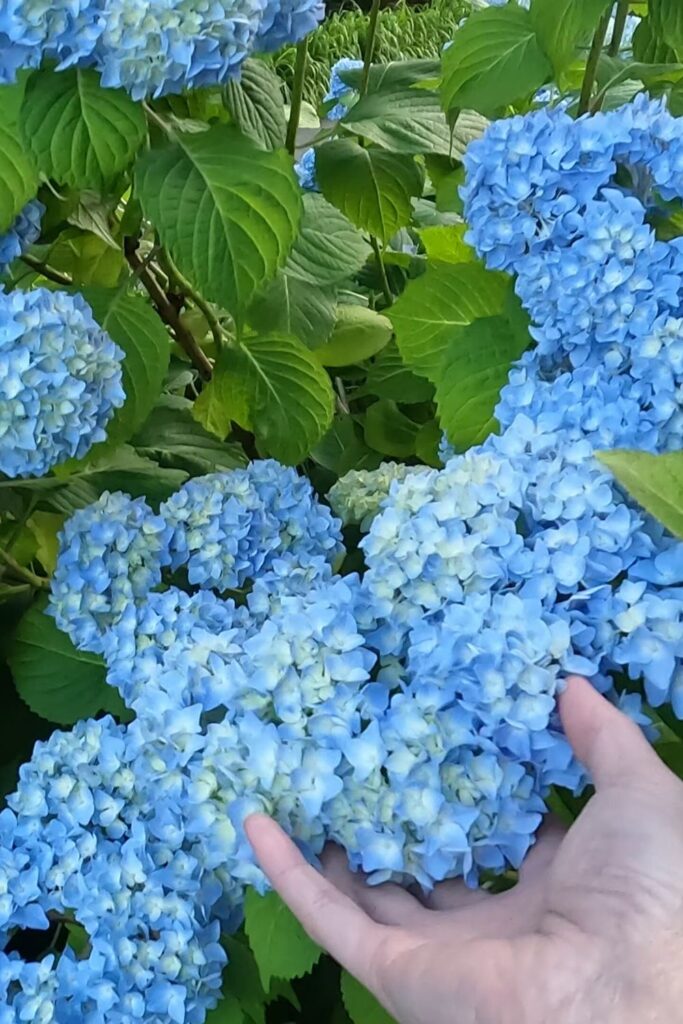
The ideal spot is one that gets morning sun and afternoon shade. Morning sun is gentle and helps your plant grow, while afternoon shade protects it from the heat of the day.
Your planting zone also makes a big difference in how much sun your hydrangeas can handle.
If you’re in a cooler climate, like Zones 5 or 6—think parts of Pennsylvania, Michigan, or upstate New York—your hydrangeas can usually handle and even benefit from more sun. In fact, without enough sunlight, they may grow lots of leaves but very few blooms.
I’m in Zone 7, which is in Connecticut. I usually stick with partial shade. But honestly, even the hydrangeas I have growing in full sun are doing just fine with very little maintenance.
If you’re in a warmer climate like Zones 8 or 9—places like South Carolina, Texas, or much of Florida—you’ll want to avoid planting hydrangeas in full sun.
The sunlight is more intense there and can easily scorch the leaves or stress the plant. In those zones, partial shade is definitely the way to go.
And here’s one more tip—avoid planting your hydrangea right under a large tree. Big trees with strong root systems will compete with your hydrangeas for water and nutrients, which can make it harder for the plant to thrive, especially if you’re trying to be a hands-off gardener.
So before you dig a hole, take a good look at how much sun the area gets, what zone you’re in, and whether a thirsty tree is nearby. A smart location sets you up for success with minimal effort.
Watering Requirements
How often should you water your hydrangeas? Honestly, it might be less often than you think.

There have been years when life got busy and I barely watered mine at all—and they still survived and bloomed beautifully. That’s because once they’re established, hydrangeas are surprisingly drought-resistant.
You definitely don’t need to water them every day. In fact, watering daily can actually harm your hydrangeas by keeping the soil too wet and encouraging root rot.
I live in coastal Connecticut, in Zone 7, and my routine is pretty relaxed. I usually water once a week—sometimes even less. If I miss a week or two, they’re fine.
But during a heatwave, I’ll bump it up to twice a week. There have even been summers where I came back from vacation and found my hydrangeas looking droopy and sad from lack of rain.
But here’s the amazing part: with just one deep soak, they perked right back up. Hydrangeas are incredibly resilient if they’re well-established.
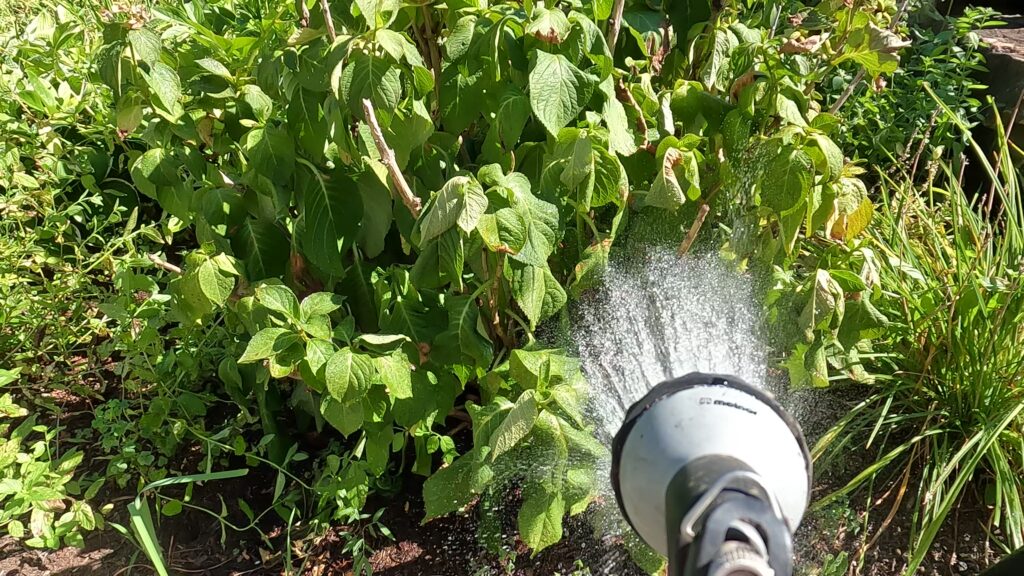
So, if you’re in Zones 5 to 7—places like New York, Illinois, or Pennsylvania—you can probably follow a similar routine: once a week is usually enough, and more only if it’s unusually hot or dry.
If you’re in warmer Zones 8 or 9, like Texas, Arizona, or Florida, your plants will need more frequent watering. In those hotter, sunnier climates, aim for at least twice a week.
And during a heatwave? You might need to water every 2 to 3 days to keep your hydrangeas from drying out. The sun in those zones is intense, and your plants will feel it.
Now, here’s an important distinction: if your hydrangeas are newly planted or not yet established, you can’t be lazy—yet. Younger plants haven’t developed deep roots and need more consistent watering to get settled.
In Zones 5 to 7, that means watering at least twice a week, and even more often if the weather is especially hot or dry.
In Zones 8 and 9, you’ll need to water those new hydrangeas every 2 to 3 days.
If you’re planning a vacation, I recommend setting up a garden watering timer to keep them hydrated while you’re away. Just be careful not to overdo it—too much water is just as harmful as too little.
Feel the Soil
So how can you tell when it’s time to water? The easiest way is to check the soil.

Stick your finger a few inches in—if the soil feels wet or soggy, hold off. If it feels dry, it’s time to water.
You can also tell by looking at your plant. If the leaves are drooping, that’s a classic sign that your hydrangea is thirsty.
And when you do water, make it count. Don’t just sprinkle the surface. Give your plant a deep soak so the water reaches down to the roots.
That’s what keeps your hydrangea healthy and strong—so you don’t have to fuss over it every day.
Hydrangea Fertilizer
People often ask me, “When should I fertilize my hydrangeas?” And the answer is: once a year!
Hydrangeas are truly set-it-and-forget-it plants. You really don’t need to fuss over them. I fertilize mine just once a year, and that’s more than enough.
I do it in early spring, right when the plant is just starting to bud and wake up from winter. That’s the perfect time to give it a little boost to support healthy growth and blooming.
I use a balanced, slow-release granular fertilizer. And because I’m a lazy gardener, I go for the easiest option: no mixing, no complicated steps.

I just take a spoon, sprinkle it directly onto the soil around the base of the plant, and I’m done. That’s it. Super simple. If you’re curious, here is the fertilizer that I use.
Now here’s something important—don’t over-fertilize. More isn’t better.
In fact, too much fertilizer can actually backfire. Your hydrangea might grow lots of lush green leaves but very few flowers.
So resist the urge to add extra. Once a year is all you need.
If you’ve just planted a new hydrangea, chances are you already added fertilizer when you planted it—either in the soil mix or as a starter fertilizer.
That initial boost is enough. After that, leave it alone until the following spring.
So remember: one good dose in early spring, and you’re good to go. No need to overthink it. Let your hydrangeas do their thing.
Hydrangea Pruning
Do I prune my hydrangeas? Honestly—no, I don’t. And when it comes to pruning, I’ve found that being lazy is actually the best approach. Hydrangeas are truly low-maintenance, set-it-and-forget-it plants.
Pruning isn’t essential at all, and in some cases, it can actually do more harm than good.
Here’s why: certain types of hydrangeas, like bigleaf hydrangeas (Hydrangea macrophylla), bloom on old wood.

That means the flower buds for next year are already formed on this year’s stems. If you cut those stems back in the fall or early spring, you’re literally cutting off next year’s flowers.
I learned that the hard way. One year, I decided to give my bigleaf hydrangea a trim, thinking I was helping it. But instead, I cut off all the developing flower buds.
The result? No blooms the following year. That’s when I learned my lesson—when in doubt, don’t prune.
So what do I do after my hydrangeas finish blooming and the flowers start to fade? Absolutely nothing. I just leave them alone. I don’t even deadhead the old blooms.
And honestly, I like the way the dried flowers look in fall and winter. They add texture and visual interest to the garden, especially when there’s snow. It’s a quiet kind of beauty.
Every now and then, if I’m feeling inspired, I’ll do a light cleanup—maybe remove a few dead branches or dried-up leaves.

But it’s not something I go out of my way to do, and it’s definitely not required for the plant’s health.
So when it comes to pruning hydrangeas, my advice is simple: be lazy, and don’t feel like you have to do anything at all. Let your hydrangeas do their thing, and they’ll reward you year after year.
If you’re interested in learning how to propagate hydrangeas the easy way, check out my article about how to easily propagate hydrangeas. It’s simple, even for lazy gardeners like us.
Get Your FREE Hydrangea Care Tracker Printable

Sign up once and you will get access to ALL exclusive content on this website. After unlocking the printable, just save the printable image and then print it. Use it to keep track of your hydrangea care! I hope you like it!
