

Nerve Plant (Fittonia albivenis) is sought after for its stunning lace-patterned leaves. It is a charming low-growing houseplant that looks great in hanging baskets or small pots. Nerve Plants are tricky to care for because it requires the high humidity and high moisture of the South American rainforests. It’s difficult to replicate this environment, so much so, that it is sometimes easiest to keep Nerve Plants in a terrarium so you don’t have to keep up with the plant’s constant need for humidity. Here are tips on how to take care of your Nerve Plant.

Nerve Plant Infographic
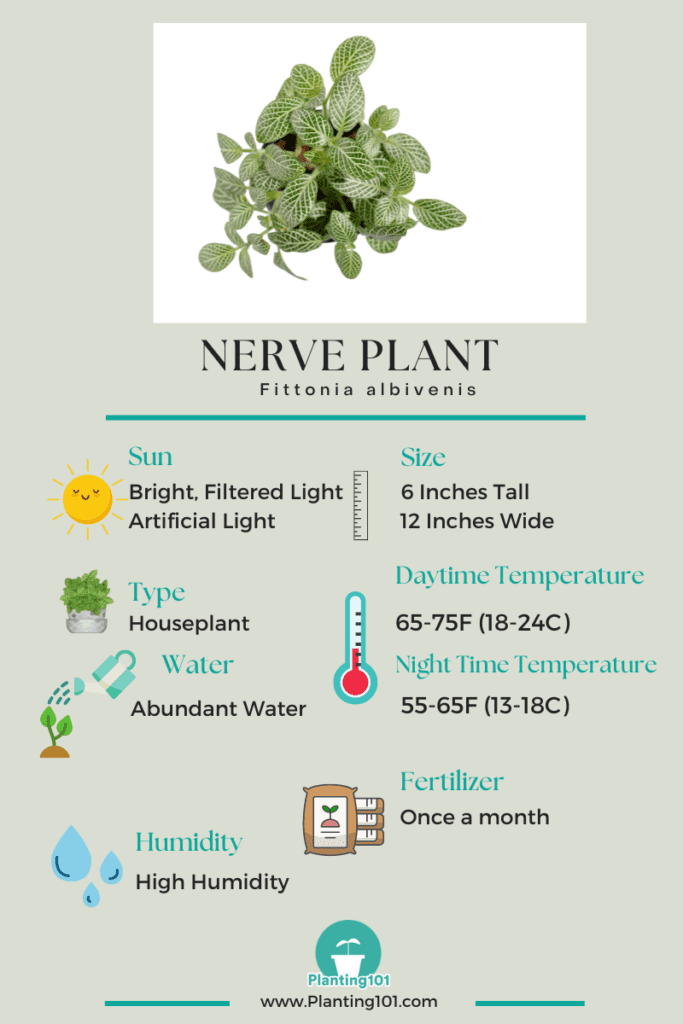
Nerve Plant Basics
| Name | Nerve Plant |
| Scientific Name | Fittonia albivenis |
| Care Level | Difficult |
| Light | Bright filtered light |
| Daytime Temperature | 65 to 75F (18-24C) |
| Night Time Temperature | 55-65F (13-18C) |
| Water | Abundant Water |
| Humidity | High Humidity |
| Potting | Well-draining, organic, all-purpose potting mix |
| Fertilizer | Once every month |
Nerve Plant: Other Names
Nerve Plant is also called Mosaic Plant, Painted Net Leaf and Silver Net Leaf.
Nerve Plant: Varieties
The most common Nerve Plant varieties are Fittonia ‘Argyroneura’ and Fittonia albivenis. Below are a few Nerve Plant varieties.

Fittonia ‘Argyroneura’- Silvery white-veined leaves
Fittonia ‘Pearcey’- Reddish veined leaves
Fittonia ‘Minima’- A dwarf variety of Fittonia ‘Argyroneura’. It is suitable for terrariums.
Nerve Plant: Size
Nerve Plant is a small plant and can grow to 6 inches high and 12 inches wide. The leaves can grow to 4.5 inches long.
Light
Nerve Plant: Sun or Shade?
Nerve Plant does well in bright, filtered light. It will also thrive in artificial light. Keep it away from direct sunlight. Nerve Plant is also sensitive to cold draft, keep it away from draft.
Placement
Best Placement for Nerve Plants
Nerve Plants are happiest in warm and humid places. Greenhouses, terrariums, and bathrooms are great places for Nerve Plants.
Water
How Often Should You Water Your Nerve Plant?
Your Nerve Plant needs to be well-watered otherwise it will completely collapse if it dries out.
Water your Nerve Plant when the top of the potting mix feels dry.
How Do You Know When to Water Your Nerve Plant?
The best way to tell when it is time to water your Nerve Plant is to feel the soil. Stick your finger in the soil 0.5 inches deep. If the soil feels dry, it’s time to water your Nerve Plant.
What Type of Water Should You Use When Watering Your Nerve Plant?
Your Nerve Plant can be watered with tap water but be mindful of the water temperature that you are using to water your Nerve Plant. Don’t use straight cold water from the tap to water your Nerve Plant. Nerve Plant prefers lukewarm water that is not hot and not cold.
When you turn on the cold water from the faucet add a little bit of warm water. You can also get to this ideal temperature by filling a watering can or pitcher with water and leaving it out overnight until the water is at room temperature.
How Do You Make Sure There is Proper Drainage for Your Nerve Plant?
Plant your Nerve Plant in a pot with drainage holes. After watering your Nerve Plant and you see water draining out of the pot’s drainage holes, make sure you empty out the accumulated water in the saucer. Don’t let your Nerve Plant’s pot sit in this puddle of water. It will cause root rot!
Do You Need to Mist Your Nerve Plant?
Your Nerve Plant is a houseplant that requires high humid conditions. Regular indoor air is too drying for your Nerve Plant. It’s best to keep your Nerve Plant in a terrarium. But if you do decide to keep it outside of a terrarium, then you should increase indoor humidity.
How to Increase Humidity Level for Nerve Plants?
The easiest way to increase the humidity level for your Nerve Plant is by planting it in a terrarium. However, if you decide not to, you can increase humidity by misting your Nerve Plant every day. Turn on the humidifier.
Another way to increase humidity is to keep Nerve Plant in a saucer filled with water. But make sure the pot is elevated with pot feet or pebbles so your Nerve Plant is not sitting directly on the water. You should also keep your Nerve Plant in a room with high humidity such as a bathroom.

Soil
What Type of Potting Mix is Best for Your Nerve Plant?
Your Nerve Plant needs a well-draining, organic potting mix.
How Do You Know When To Repot Your Nerve Plant?
Repot your Nerve Plant when it’s outgrowing its current pot. Repot in a container with a diameter 2 inches larger than the current pot.
Fertilizer
Do You Need to Fertilize Your Nerve Plant?
Your Nerve Plant should be fertilized once a month.
What Fertilizer Should You Use on Your Nerve Plant?
Use liquid or powder, organic fertilizer with a higher ratio of nitrogen.
Propagation
How Do You Propagate Your Nerve Plant?
Your Nerve Plant Nerve Plant Plant is easy to propagate. You can propagate your Nerve Plant by stem tip cutting. Below are steps on how to propagate Nerve Plant by stem tip cutting:
1. Take a Stem Tip Cutting of Nerve Plant Plant (include a node)
Pick a stem with a node. Cut below the node.
2. Place Nerve Plant Stem in Jar of Water
Place the Nerve Plant stem into a jar of water and wait for it to grow roots. To help it focus its energy on growing roots, make sure your stem has a maximum of 2 leaves. Cut off extra leaves as needed.
Another way to stimulate root growth is to dip your stem cutting in root hormone and plant it in moist sand. I personally prefer the jar method so you can easily see the roots come out. Know that not all stem cuttings of Nerve Plant will grow roots, so to be safe, cut a few stem cuttings so you will at least get one with roots.
3. Plant Stem Cutting in New Pot
Once the roots grow, plant these stem cuttings into a new pot. Water the new plant immediately after planting. Then water every 2-3 days until the roots are established.
4. Place New Nerve Plant Plant in a Spot with Bright Indirect Sun
Place your new Nerve Plant plant in a spot with bright indirect sunlight. Don’t put it in direct sunlight.
Common Problems of Nerve Plant Care
The most common problems that affect Nerve Plant are aphids, plant collapse, and root rot.
Nerve Plant: Looks Wilted (Soil is Wet)
Nerve Plant Problem: Your Nerve Plant looks wilted even if the soil is wet. Check for root rot by pulling the plant out and examining the roots. If the roots of your Nerve Plant plant look mushy (healthy roots are firm) and the roots are gray to black in color, these are telltale signs of root rot.
Cause: Root rot is caused by fungus and is a serious problem for your Nerve Plant. Root rot is a result of wet soil due to overwatering or poor drainage.
Solution: When your Nerve Plant is afflicted with root rot the chance of survival is slim. Your best course of action is to throw your Nerve Plant out and start over with a new plant. This time don’t overwater your Nerve Plant and make sure there is good drainage in the pot.
Nerve Plant: Lots of tiny green, grey, and brown insects under the leaves
Nerve Plant Problem: You see a lot of tiny green, gray, and brown insects all over the underside of the leaves of your Nerve Plant. There are also sticky clear residues on leaves and stems. Plus the tips of the stems have curled up and look deformed.
Cause: Aphids could be the problem but you should make sure by taking a close look at the insects. There should be 2 tubes on the backside of the insects. Use a magnifying glass to identify aphids.
Solution: Aphids are common in houseplants. You can get rid of aphids by washing the aphids off with water or soapy water. You can also use rubbing alcohol. Or spray your Nerve Plant plant with insecticidal soap and horticultural oil to get rid of the aphids.
Nerve Plant: Plant wilted and completely collapsed
Nerve Plant Problem: Your Nerve Plant has wilted and completely collapsed.
Cause: Your Nerve Plant requires high humidity and abundant water. If the soil dries out, your Nerve Plant will wilt.
Solution: Water your Nerve Plant immediately. If it’s only been a few hours then your Nerve Plant should recover and come back. However, if it’s been days, your Nerve Plant will probably not recover. Make sure you have good drainage. Make sure you have drainage holes at the bottom of the pot. Also, make sure the drainage hole does not sit directly on the accumulated water in the sauce. Elevate the pot by using pebbles or pot feet.
You May Also Be Interested In:
How to Take Care of Haworthia (infograph)
How to take Care of Ponytail Palm (Infograph)
How to take Care of Swiss Cheese Plant (Infograph)
Planting 101 participates in affiliate programs including Amazon Associates Program and may earn commission from qualifying purchases at no extra cost to you. Thank you for your support.