
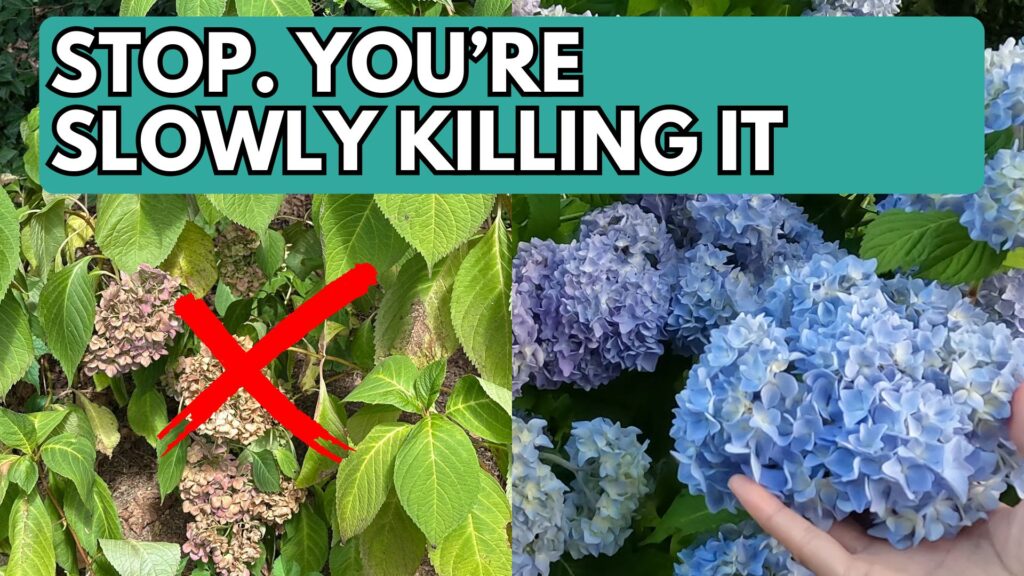
Are you wondering why your hydrangea barely has any flowers? It’s a plant that just refuses to thrive, no matter what you do.
Here is the truth nobody tells you: most hydrangea problems are not about what you are doing RIGHT NOW. They are about mistakes that were made weeks, months, or even years ago. Mistakes that silently punish your plant season after season.
Below, I am going over the deadliest hydrangea mistakes, the ones that are hard to undo. Some of these will take years to recover from. One of them cannot be fixed at all.

Planting in the Wrong Location
One of the most common mistakes in hydrangea care happens before the plant even goes into the ground. Planting your hydrangea in the wrong location is one of the hardest mistakes to fix because by the time you realize you made it, your plant is already established, and trying to move it will set you back years.
Location is everything with hydrangeas. They thrive in a location that receives morning sun and afternoon shade. That gentle morning light gives them the energy they need for photosynthesis, while protection from the harsh afternoon sun prevents their leaves and flowers from scorching and wilting.
Here is why this mistake is so painful to fix. Moving a mature, established hydrangea is traumatic for the plant. You will lose blooms for at least one to two seasons. The roots will need time to re-establish. And there is always a risk that the plant does not survive the move at all.

You will especially want to avoid west facing spots, which provide little protection from the sun’s harshest rays. You should also check for trees and structures that will throw too much shade on your plant.
The key is to get the location right the first time. Walk your yard at different times of day before you plant. Watch where the shade falls in the afternoon. Take some time to observe before planting. Trust me, it will save you years of frustration.
Pruning
This is the mistake that devastates more hydrangea gardeners than anything else. The worst part is that it is done with the best intentions. The biggest mistake people make with hydrangeas has to do with pruning.
Here is the science you need to understand. Most popular hydrangea varieties bloom on OLD wood. That means the flower buds for next summer are formed on this year’s stems. Those buds sit on the plant all winter, waiting for spring.

If you go out in the fall and tidy things up, or do a hard cutback in early spring to make the plant look neat, you have just cut off every single bloom for next year. The plant will grow back lush and full of leaves. But there will be no flowers. No blooms for that entire season.
Here is the key rule: only new wood bloomers, like panicle hydrangeas and smooth hydrangeas, can be pruned. For old wood hydrangeas like Bigleaf hydrangeas, don’t prune. You might accidentally prune off the flower buds.
But if you already made that mistake of pruning, don’t worry, the fix is to wait. Stop pruning and give the plant a full season. Next year you will see blooms again.
Overwatering
Here is a mistake that surprises people, because hydrangeas have a reputation for being thirsty plants. When in fact the opposite is true. Overwatering can lead to root rot and yellowing leaves, while underwatering causes drooping, crispy foliage, and fewer blooms.
It is a fine line, and many gardeners end up swinging too far in either direction, especially during hot dry spells or unusually rainy seasons.
The reason why overwatering is particularly deadly is that root rot is a silent killer. By the time you see yellowing leaves or a wilting plant, the roots have already been suffocating underground for weeks.
And once root rot sets in, you cannot just dry things out and call it fixed. You would need to dig the plant, trim the rotted roots, and hope for the best. And even then, recovery is not guaranteed. You’re better off starting all over again with a new plant than trying to save your hydrangea from root rot.
Hydrangeas prefer well-drained soil and should only be watered at the root when the top inch of soil is dry. That is your rule of thumb. Stick your finger an inch into the soil. Still moist? Leave it alone.
And please, do not water on a rigid schedule. Water based on what the plant and the soil are actually telling you. A rainy week means you skip watering entirely. A hot dry stretch may mean every other day. Let the soil guide you, not the calendar.
Planting Too Far From Your Water Source
This one is so obvious, but many beginners make this mistake. You find the perfect spot. Great light, looks amazing from the street. You plant your hydrangea, then you realize the hose does not reach your plant.
Filling a watering can and trudging back and forth becomes a miserable chore. So you start skipping waterings. The plant suffers, especially newly planted hydrangeas, since they need watering to establish roots. As a result, these hard-to-reach plants often end up dead.
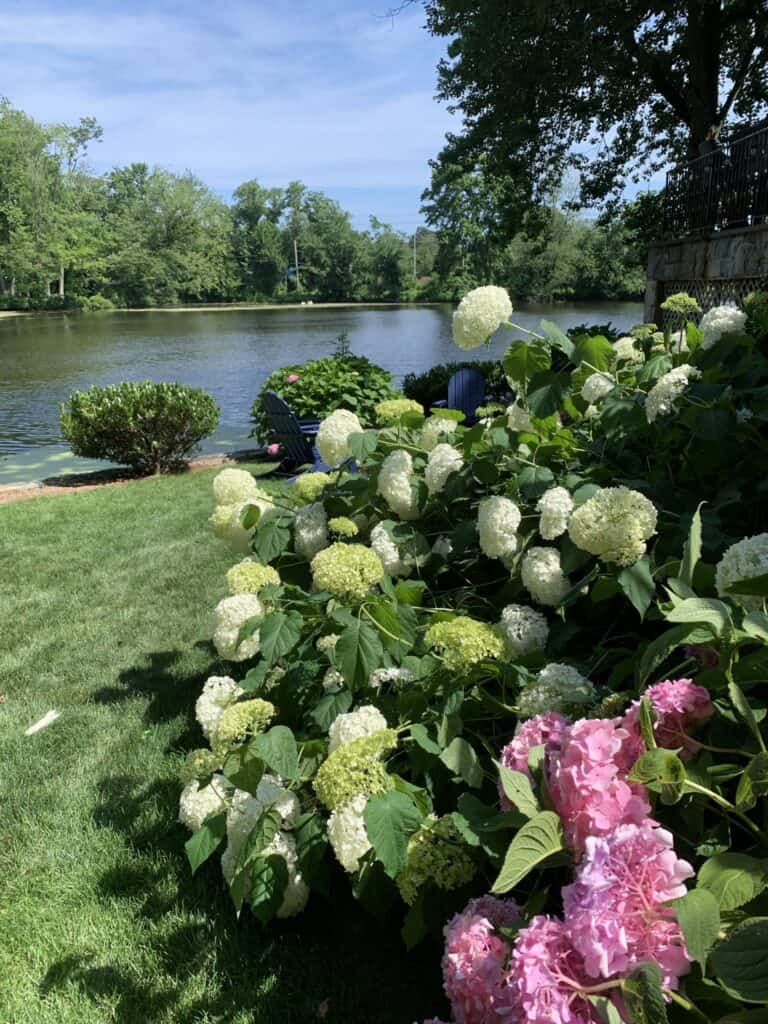
Hydrangeas are not drought-tolerant plants. Miss a few waterings during a heat wave and you will come outside to a collapsed plant. Do it repeatedly in the first year and you will stunt its root development.
Here is the fix, before you dig a single hole, walk your yard with your hose fully extended. Mark where it reaches. That is your hydrangea planting zone.
Think about your yard in terms of zones. Plant perennials that need regular watering within easy reach of your house and hose. Save the far corners for plants that can handle dry spells on their own.
If your heart is set on a far corner of the yard, invest in a longer hose, a second hose reel, or a simple drip irrigation line before you plant.
Too Much Shade
This is a mistake that is extra frustrating because it happens so gradually, you barely notice it until the damage is done.
Your hydrangea looks fine. It is green. It is alive. It is not dying. But year after year, the blooms are sparse and the plant just never looks like the ones you see in garden magazines. Too much shade is often the invisible culprit.

Now, hydrangeas have a reputation as shade plants, and that is only half true. Because too much shade is not good, the key is partial shade to protect your hydrangea from the harsh afternoon sun.
Here is what actually happens in deep shade. The plant puts almost all its energy into growing toward light. There is barely enough energy left over for blooming. So you get a plant with a handful of sad, undersized flowers.
The sneaky part? This mistake gets worse over time. A spot that had decent light when you planted may get shadier every year as surrounding trees and shrubs mature and fill in. What worked in year one can be a serious problem by year four.
The fix depends on how established the plant is. Young plant? Relocate it. Mature plant? You may need to do selective pruning of surrounding trees and shrubs to let more light filter through.
And when shopping, match the variety to your light conditions. Panicle hydrangeas tolerate more sun and handle shadier conditions better than most. If your yard is heavily shaded, panicles are your best friend. Do not fight your yard, work with it.
Planting on an Unprepared Slope
Hydrangeas can grow on a slope. But here is the catch, an unprepared slope is a completely different story, and this is where gardeners get into trouble.
Without bolstering plants on a slope in some way, water runs right off and so do the nutrients. You water it, and the water streams right past the root zone before it can be absorbed. You fertilize it, and the nutrients wash downhill.
One of the perks of sloping terrain is that it drains quickly, which hydrangeas generally like, but the flip side is that water rushes away before the roots can drink it in.
So you end up with a plant that is technically in well-drained soil but is chronically thirsty and underfed at the same time. It just slowly declines, season after season, and you cannot figure out why.
The fix is straightforward. Use rocks to build up a level planting pocket around each plant. If you have a significant slope, you may eventually need a proper retaining wall.
A Late Frost Kills All Your Buds
Technically, this is not actually a mistake you made, since it is entirely out of your control. I am including it in this video because if it happens to you, I do not want you tearing your garden apart trying to figure out what you did wrong. You did nothing wrong. The weather did this.
Here is what happens. Bigleaf and oakleaf hydrangeas form their flower buds in late summer and autumn, and those buds sit on the plant all winter just waiting for spring. Everything looks fine.

The plant breaks dormancy, the buds begin to swell, and then one night in April or May, a hard frost rolls through. And just like that, every single bud on every single stem is dead.
The plant will rebound. The leaves will look full and healthy. And then you will wait for blooms that are never going to come. Not this season. That’s because the buds are gone.
This is one of the most demoralizing things that can happen to a hydrangea gardener, especially because the plant looks so good. There is nothing to diagnose. Nothing to fix.
You just have to wait for next season for your hydrangea to bloom. And don’t feel bad, it’s not just you. Your neighbors are experiencing the exact same thing.
Get Your FREE Hydrangea Care Tracker Printable

Sign up once and you will get access to ALL exclusive content on this website. After unlocking the printable, just save the printable image and then print it. Use it to keep track of your hydrangea care! I hope you like it!
